Iran’s “Toll Booth” in the Strait of Hormuz: How a $2 Million Per-Ship Fee Rewires Global Oil, Shipping, and Finance
A financial-analyst breakdown of Iran’s “toll booth” model in the Strait of Hormuz-how IRGC selective access works, why some ships pay ~$2M per voyage, and how yuan settlement and CIPS could reshape oil, shipping, and enforcement math.
Quick framing: The Strait of Hormuz is not just a geographic choke point. It is the world’s energy plumbing. When control shifts from “free navigation” to “priced passage,” the impact shows up everywhere: freight costs, insurance math, FX settlement, oil prices, and ultimately household budgets.
Here’s the clean, financial-analyst read on what Iran has done, how the toll booth mechanics work, who gets access, how much is being paid, and why the strategic fight is now as much about money flows as it is about naval power.
1.1) What Iran changed: from open corridor to a “rent-seeking” system
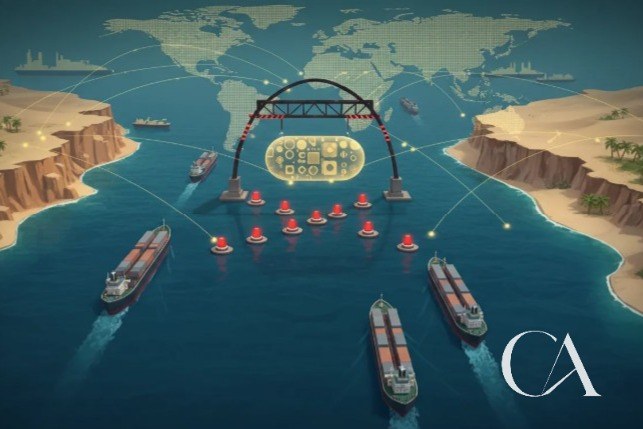
Since mid-March, Iran has effectively converted the Strait of Hormuz into a toll booth.
Old reality: Ships typically used the normal shipping lanes through international waters where freedom of navigation is protected under the United Nations Convention on the Law of the Sea.
New reality: Iran pressures ships away from the usual two-way lane and toward an alternate route near the Iranian coastline between the islands of Keshum and Larak.
Control lever: The Islamic Revolutionary Guard Corps (IRGC) reviews ship details and then decides whether to grant passage, along with the routing instructions and fee.
The key economic point is not that Iran “blocked” the strait with ships across its width. The impact is commercial and legal. The old framework that made transit normal broke, so transit becomes rational only for a smaller group of operators willing to pay.
2.2) The mechanics: how the IRGC acts like a toll booth
Under this system, IRGC units review ship information before allowing transit. Multiple reports describe a checklist style process. The IRGC checks four elements:
Nationality
Ownership
Cargo
Crew
According to reporting cited by major outlets, if any of those four elements links the ship to America or Israel, the ship is denied. If the ship clears Iran’s criteria, it is routed through the Iranian-controlled corridor and priced.
Iran’s enforcement approach also reflects a broader concept: selective access.
Friendly nations get passage.
Hostile nations face denial.
Price is not fully standardized. It is negotiated ship-by-ship.
3.3) How much is it: $2 million per voyage, paid in yuan
The headline number is $2 million per voyage for some ships. Importantly, it appears to function like a ceiling in many cases, while some diplomatically preferred routes may cost less or effectively be lower due to negotiation.
Two operational details matter for investors and strategists:
Currency: at least some transits have been paid in Chinese yuan (not dollars).
Intermediaries: Chinese maritime and financial intermediaries can broker the transaction and handle settlement through China’s alternative messaging and payment infrastructure.
4.4) The real-world finance angle: why yuan settlement matters
This is where the story goes beyond “maritime fees” and becomes a structural challenge to U.S.-linked financial leverage.
The transcript’s core claim, consistent with the reporting referenced in the video metadata, is that toll payments and related oil transactions can be processed through CIPS (China’s Cross-Border Interbank Payment System), which reduces reliance on SWIFT, the U.S.-controlled messaging backbone.
In practical terms:
It normalizes settlement in yuan for shipping-adjacent payments tied to Iran.
It builds operating muscle for handling sanctioned-country commerce through alternate rails.
It creates friction for U.S. enforcement because sanctioning the infrastructure can broaden trade spillover risk with China.
5.5) Scale and disruption: why $2 million per ship changes the global price
At first glance, $2 million seems small compared to tanker values. The macro damage comes from frequency.
Reported shipping data described the order of magnitude shift:
Before the disruption: about 110 ships per day were passing through the Strait of Hormuz.
After the toll booth took effect: fewer than 10 ships per day.
March total: the entire month’s fewer transits were less than the total that would normally pass on a single pre-war day.
Waiting ships: nearly 2,000 ships reportedly queued outside the strait, with 20,000 seafarers affected.
Also, the bottleneck is not a physical wall. The strait is roughly 21 miles wide. The bottleneck is insurance and legal risk.
When insurance collapses or risk pricing spikes, the expected cost of transiting rises faster than the revenue from shipping. That is why queues form and why the market impact becomes visible in oil prices.
6.6) Oil prices: the tightening feedback loop
With fewer cargoes moving, global supply tightens. That shows up immediately in benchmarks.
Reporting in the transcript cited oil moving above $107 per barrel (Brent) and described an IEA view framing the situation as worse than the 1973 and 1979 crises combined. It also referenced market estimates that high oil could persist.
From a financial analyst standpoint, the transmission mechanism is straightforward:
Lower throughput through Hormuz reduces available crude and product supply.
Refineries draw down emergency stocks.
Producers and traders reprice future shortages.
Gas and food inflation pressure accelerates because energy costs ripple into logistics and input costs.
7.7) Who gets access: “friendly” gets routed, “hostile” gets taxed by denial
Iran’s public-facing narrative is about security and war. The commercial reality is selective commercial routing.
Reported examples of ships receiving access include:
India: passage for four LPG tankers.
China: ships getting through, supported by financial and diplomatic posture.
Malaysia: ships getting through.
South Korea: ships getting through.
Egypt: ships getting through.
This is the diplomatic map embedded in the toll booth.
China provides diplomatic cover and financial infrastructure.
Malaysia has strategic logistics and transshipment relevance.
South Korea’s history includes nuclear diplomacy with Iran.
Egypt controls the Suez Canal, which becomes an alternative shipping pressure valve.
India’s situation illustrates the two-step nature of the system: publicly challenging the legality while still accepting free passage for essential cargo. For a country managing energy security, “access” often dominates ideology in the short term.
8.8) The leadership risk: Israel’s killing of the IRGC naval commander
The transcript reports that Israel killed Commodore Alresza Tangiri, the IRGC Navy figure overseeing closure mechanics and the enforcement pattern.
The critical analytical question is whether leadership removal ends the system. The answer described by maritime analysts is no:
The IRGC is institutional, with command structure extending below the top commander.
Patrol boats and the alternate route still exist.
Iran’s legislative process to formalize the toll continues.
9.9) The next phase: turning an improvised toll into permanent “sovereignty”
This is the piece many observers miss. Iran isn’t just charging fees in wartime conditions. It is working to institutionalize the right to charge.
Iran’s parliament is reportedly preparing legislation to impose and legally recognize fees and oversight for vessels transiting the Strait of Hormuz. The strategic reference is deliberate: Iran wants a Suez Canal-style cash machine.
Why that matters:
The Suez Canal model created predictable sovereignty-linked rent collection.
It turned a geopolitical corridor into a durable fiscal lever.
It would, if replicated, make future negotiations harder because fees become a legal norm rather than an emergency improvisation.
10.10) What the U.S. is doing and why it is not cleanly working
Two tracks appear to be running in parallel:
Military posture: building capability in the region (amphibious and airborne deployments).
Economic coercion: the potential to sanction intermediaries enabling toll settlement.
Analysts in the transcript emphasized a key constraint: sanctioning Chinese financial intermediaries could trigger China in a trade-war direction, at a moment when higher oil prices and rising inflation risks are already stressing the global economy. So the U.S. may hesitate to target the exact financial backbone supporting the system.
11.11) The “so what” for your wallet: energy inflation is the headline transmission
When Hormuz throughput falls from ~110 ships per day to fewer than ~10, that creates a supply shock. Supply shocks usually show up as:
Higher crude prices
Higher refined product costs
Higher freight and insurance costs
Downstream pressure on food and consumer prices through logistics and input costs
In short: the toll booth functions like an additional “tax layer” on global trade, and the market is currently charging it through oil and freight pricing.
IMPORTANT DISCLAIMER: This document is provided for informational and educational purposes only. It does not constitute investment, legal, tax, or other professional advice, and nothing herein should be construed as a recommendation, offer, or solicitation to buy or sell any security. Information is from sources believed reliable but not guaranteed; certain figures are estimates that may prove incorrect. Past performance is not indicative of future results, and all investments involve risk, including possible loss of principal. Conduct your own due diligence and consult a licensed professional before investing. Carlos Artiles accepts no liability for any loss arising from use of this material.
CARLOS ARTILES · Strategy. Growth. Life by Design.Informational use only — not investment advice





Comments (0)
No comments yet — be the first.